Experimental Kitchen
The Nutty History of an Invented Tradition
A three-part history of pecan pie in Mississippi
Part One: The Most Popular Recipe
We had picked the pecan up on half. Since we had four sacks, I had expected Mr. Wheeler to give us two of them. But instead he measured them out, gallon for gallon, to make sure we didn't have an ounce more than he did. . . . That Saturday morning Mama and Raymond drove the pecans to Woodville, where they could get eighteen cents a point instead of the fifteen cents they got paid in Centreville. In all we had picked up a hundred and twenty dollars' worth. Mama used the money to buy school clothes for us—shoes, dresses, and pants.1 Anne Moody
Perhaps the most distinctly southern pie is the pecan pie. . . . Children were sent out to gather the pecans that fell, and when mixed with the farm dairy products and corn syrup that were in every southern cupboard, the nuts produced a rich dessert.2 Angie Mosier
As anyone who has ever made the mistake of accepting an invitation to Thanksgiving dinner at my house will attest, I am not a good pie maker. This is in part due to a lack of trying. I generally only bake one or two pies each year and I make them for Thanksgiving. My wife, a very skilled former professional chef, has no interest in baking pies, so despite my lack of talent, it falls to me to uphold the grand tradition of Thanksgiving pie making. I make my own crust, which generally requires a well-swung cleaver to cut, and fill the cement-like creation with whatever kooky, experimental recipe was featured in the New York Times in the run-up to the holiday. No one ever asks to take a slice home with them.
So nothing about my early morning, early November adventure in pie making was expected or, perhaps, welcomed, but I was obsessed. It started with a simple fact. Suwan Aryal and I have assembled a database of recipes extracted from the over 100 Mississippi community cookbooks published before 1970 digitized by The University of Southern Mississippi. The data shows that the most common recipe is for pecan pie.
Pecan trees are native to Mississippi, but it was not until the late nineteenth century that new cultivation techniques produced consistent, large, and easily shelled nuts.3 One of the most successful of these new trees produced “paper shell” pecans and was bred, nursed, and sold commercially by Colonel William R. Stuart of Ocean Springs in Jackson County, Mississippi. The Stuart Pecan Company successfully marketed both its trees and its nuts at events like the 1893 Columbian Exposition, and was soon supplying trees throughout the South.
The boom in pecan production was as much a real estate boondoggle as an agricultural revolution. As food historian Andrew Smith writes:
At the time, the cotton crop in the South was devastated by the boll weevil, and property values had collapsed. Northern companies purchased vast acreage in the South, planted paper shell pecans, and sold sections of the plantings as investments. One company that excelled at this was the Oak Ridge Pecan Company, based near Chicago. It purchased land in Florida and then sold it at a substantial profit. . . . Another Chicago-based land scheme was the Mobile Farm Land Company, which sold paper shell pecan acreage around Mobile, Alabama. It offered an Assured Income for Life and a Home for Retirement Adjoining a City of 75,000 People on the Gulf Coast.
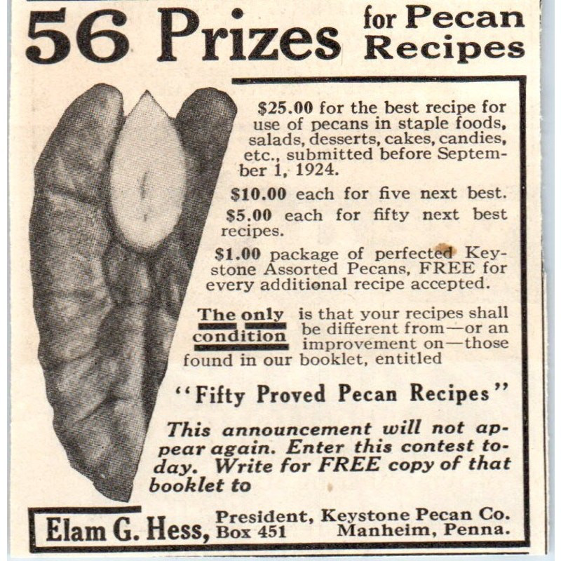
Yet another company that engaged in land speculation was headed by Elam G. Hess, the president of the Keystone Pecan Company in Manheim, Pennsylvania. It was formed in 1912, when he acquired 10,500 acres of land near Albany, Georgia, and planted 20 trees to the acre, for a total of 210,000 trees.7
There was one success story, pralines. Originally called “plarines,” the sugary candies were sold by Black women street vendors in New Orleans. As Anthony Stanosis writes in his recent book on the invention of the New Orleans praline tradition, “by the 1920s, the term ‘pralines’ had become synonymous in the United States with the use of pecans.”12
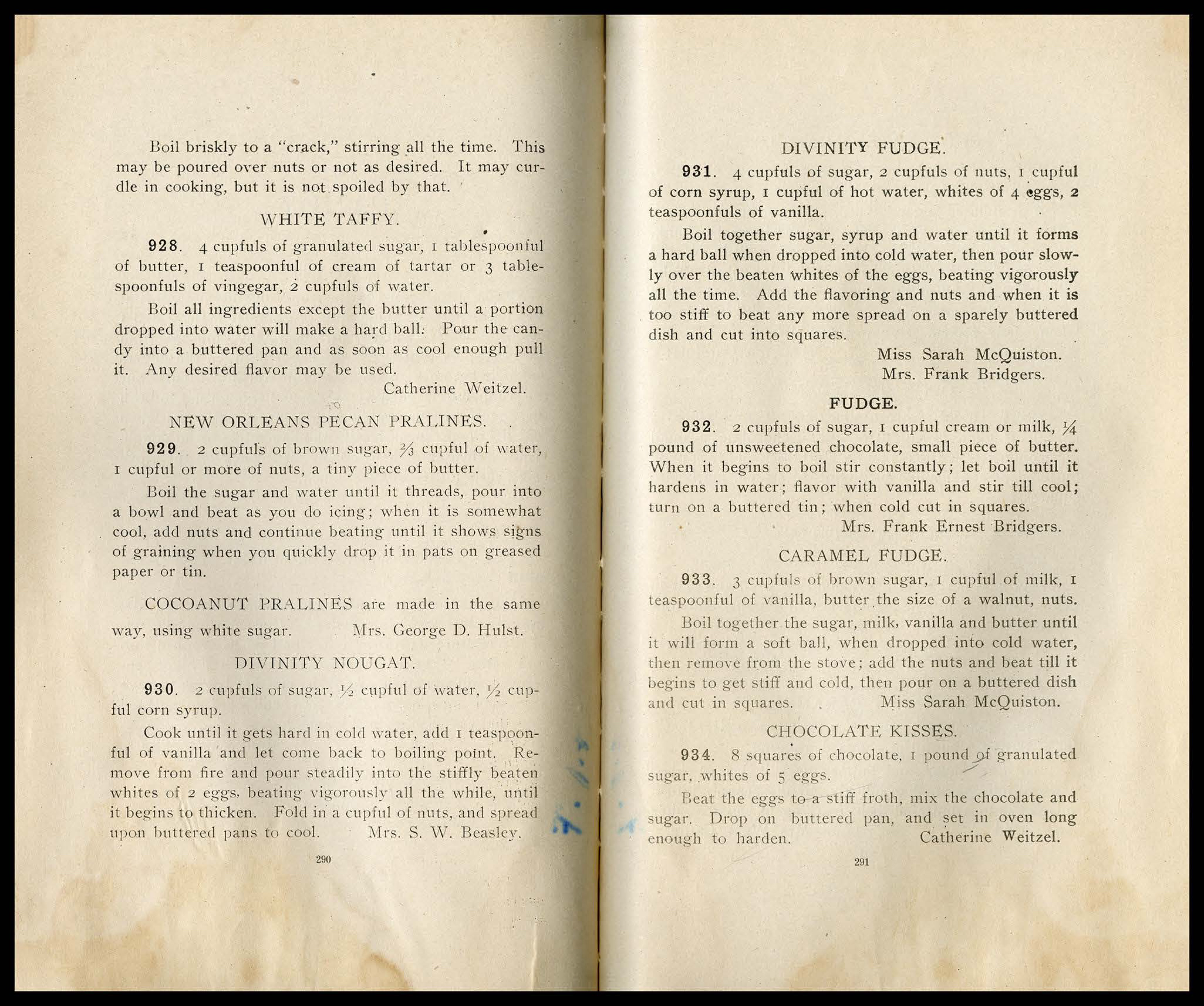
Pecan pie seems to have made its first appearance following the Civil War. Andrew Smith observes that the first “located” recipes appeared simultaneously in Harper's Bazaar and Texas Siftings on February 6, 1886. Although custard pecan pie recipes began appearing in cookbooks, the dessert was not especially popular. Reflecting the tepid reception the custard version of pecan pie enjoyed, our database contains only one pecan pie recipe prior to the late 1920s. It is called simply “Nut Pie.”
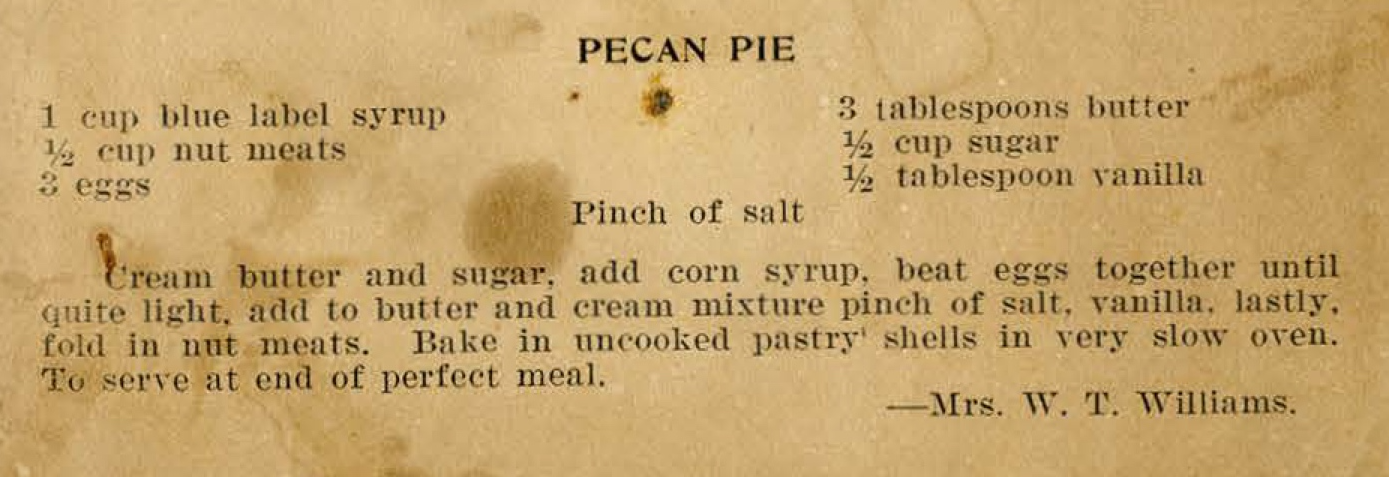
A number of scholars, most notably Rebecca Sharpless, Rossi Anastopoulo, and Sarah Wassberg Johnson, have debunked the Karo origin story. They have documented recipes for corn-syrup pecan pie printed in cookbooks before 1930 when Karo claims the recipe was invented. Our database of Mississippi community cookbooks includes evidence of this as well. The Vicksburg Floral Club Cook Book of 1928 has a recipe for corn-syrup pecan pie and the Greenville Home Economist Cook Book of 1930 has two.
If the Karo story is a fiction and Karo did not invent the modern pecan pie, who did? Like a mystery novel, this first installment of our tale ends with a cliffhanger. (Part two will offer an answer, and although it is neither simple nor definitive, it will explain why I made that pie.)
Footnotes
- Anne Moody, Coming of Age in Mississippi (Dell Publishing, 1976), 92-3. ↩
- Angie Mosier, “Pies,” in Foodways, ed. John T. Edge, v. 7 (UNC Press, 2007), 225. ↩
- “History,” The Pecan Toolbox, accessed November 22, 2025. ↩
- Andrew F. Smith, “The Pecan: A Culinary History,” 7. ↩
- Stanosis, 35–53, 186. ↩
Part Two: The Sticky Wicket of Pecan Pie's Origins
Let's start with the known facts. Pretty much all the forensic analyses of the origins of the modern pecan pie agree that it was inspired by a number of previous recipes, including the custard pecan pie and other custard and syrup pies such as chess, sugar, and molasses pie. One theory dates the first modern pecan pie to at least 1900 and was offered by Rebecca Sharpless in a blog post for UNC Press. Her research led her to Slidell, Louisiana.
Into the computer I went one more time, and I hit pay dirt with A Book of Famous Old New Orleans Recipes Used in the South for More than 200 Years, a slender volume that appeared in the Crescent City in 1900. There on page 47 is the proof: a pecan pie made with eggs, sugar, “Louisiana syrup,” pecans, butter, vanilla extract, and pecan halves. The cookbook editor noted, “The little lumber town out of Orleans, seems to be the original home of pecan pie. Signs all over Slidell advertise the pecan pie and many New Orleanians drive out to buy them during the season.” The pie uses cane syrup, not Karo, but it's very close to PPAWKI [pecan pie as we know it]. So. Slidell. Cane syrup. 1900.2
A closer look at the editor's note raised additional questions. In 1900, when this cookbook was apparently published, there were fewer than 10,000 automobiles on the road in the United States and no direct roadway between New Orleans and Slidell. Yet the note implied that it was motorists making the trek to Slidell to purchase its famous pies. It is becoming increasingly clear that the recipe and notes were added after 1928.
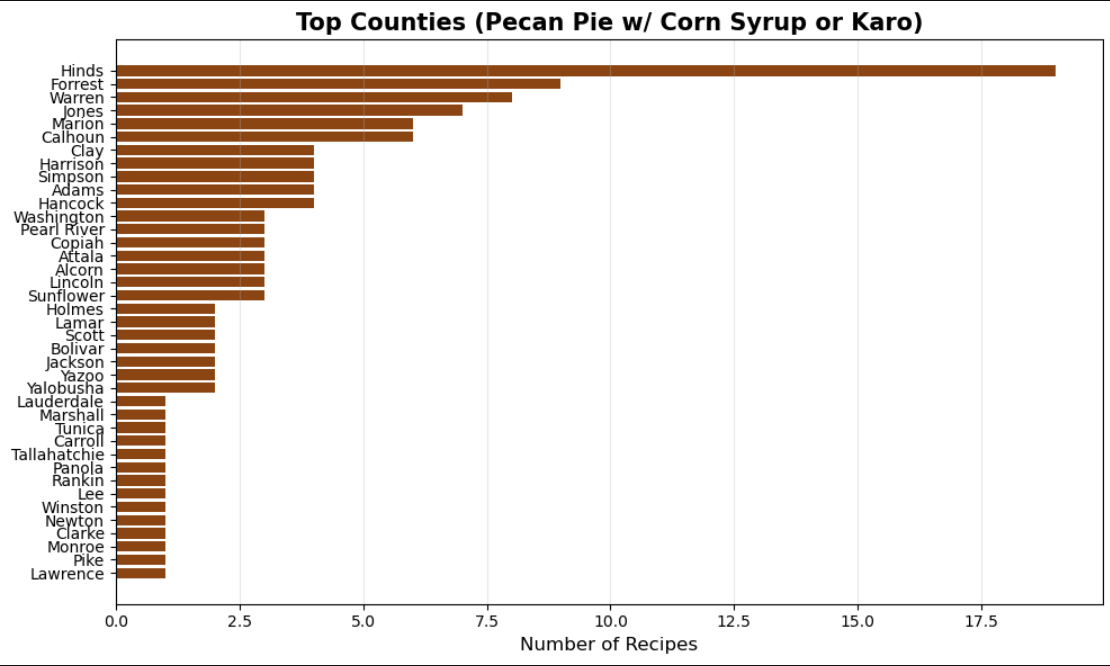
The best clues to the origins of the modern pecan pie might be two recipes from 1925, the first two known recipes for modern pecan pie. Rebecca Sharpless located one in a Dallas community cookbook produced by the Sunday school class at First Baptist Church in Dallas. A second recipe was published in 1925 in an advertising cookbook created by Elam G. Hess' Keystone Pecan Company.
There was only one way to know if a 1916 Texas recipe represented a missing link, and that was to make the pie. My spouse helped. Despite the store-bought Pillsbury crust, this is the best pecan pie I've ever had. I found the sugar syrup a little less cloying than Karo and the milk made it a little bit creamier, but this very sweet, gooey pie is not a custard pie. It has both the taste and texture of a modern pecan pie made with corn syrup.
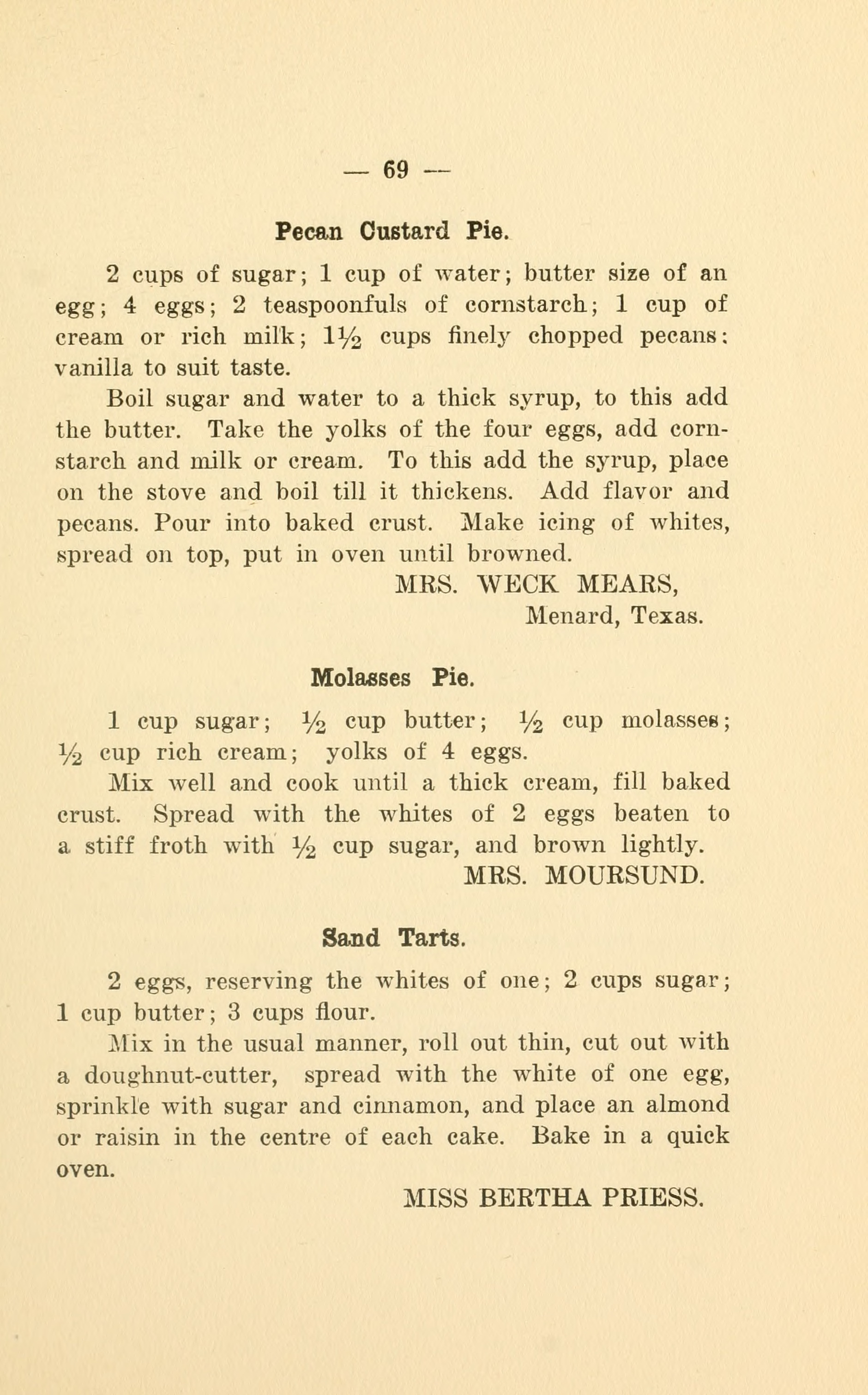
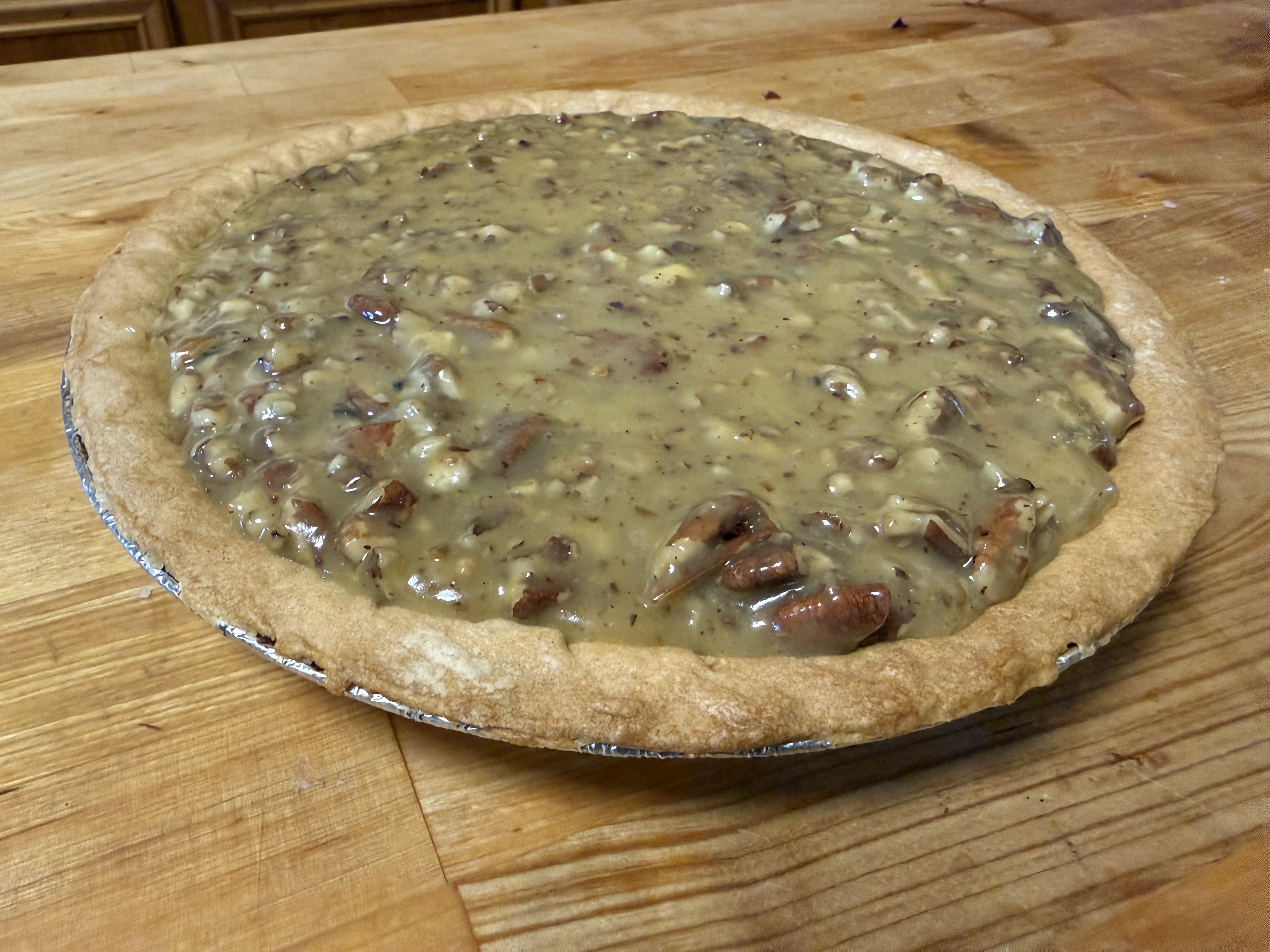
Is this the missing link between pecan custard pie and pecan Karo pie? No, but it is probably one of the many evolutions that eventually produced the modern pecan pie. These cooks, steeped in the experience that came from making molasses pie, chess pie, plantation pie, sugar pie, vinegar pie, and others, experimented and innovated and pecan pie slowly evolved. For more on that story, you will have to read part three.
Footnotes
- Rebecca Sharpless, “A Fresh Look at the History of Pecan Pie,” UNC Press Blog, last modified November 16, 2022. ↩
Part Three: Too Big Even for Texas
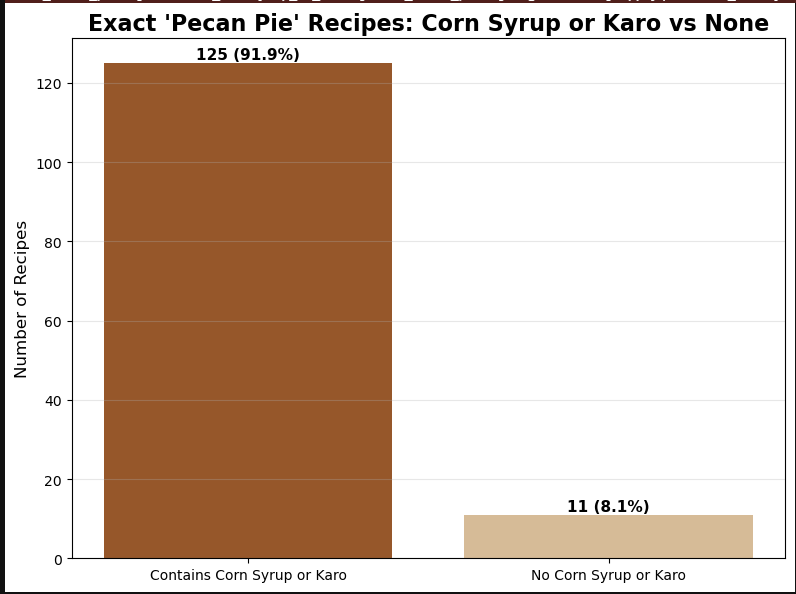
The Mississippi Community Cookbook Project's experimental AI database does not provide much additional insight into the origins of the pecan pie, but it does provide some evidence of the pie's popularity and the nation's embrace of this dessert. The number of pecan pie recipes in our database alone demonstrates how quickly pecan pie's popularity rose once custard gave way to corn syrup. Even though the first corn syrup recipes for pecan pie do not appear in our database until 1928, pecan pie recipes are the most numerous recipes in our digitized collection of over 100 Mississippi cookbooks (around 20,000 recipes) published before 1970.
Recipe titles also provide insight into the perceived origins of these recipes. Texas had a long history with pecans and in the first few decades after pecan production took off in the early twentieth century, Texas dominated the trade. Although Texas was never as closely linked to pecan pie as Boston was to beans, Maryland to crab, or New Orleans to pralines, it was not uncommon for pecan pie to be referred to as Texas Pecan Pie.
The ascendance of Lyndon Baines Johnson to the Presidency seems to have briefly revived Texas' claim to pecan pie. Articles on the President's diet often referenced “popular Texas dishes” such as pecan pie, and the Karo corporation launched an advertisement for “VIP Pecan Pie” in 1964.
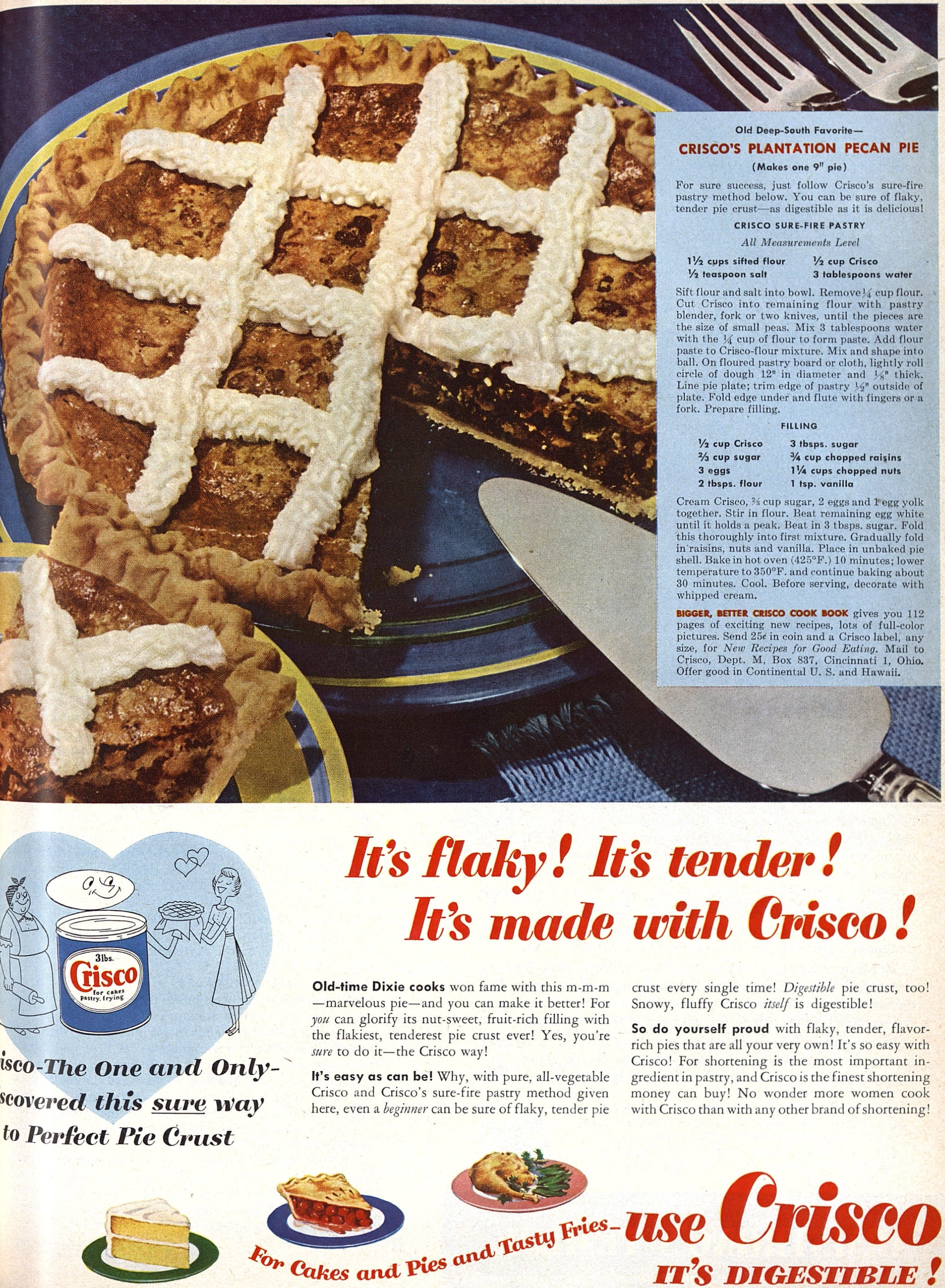
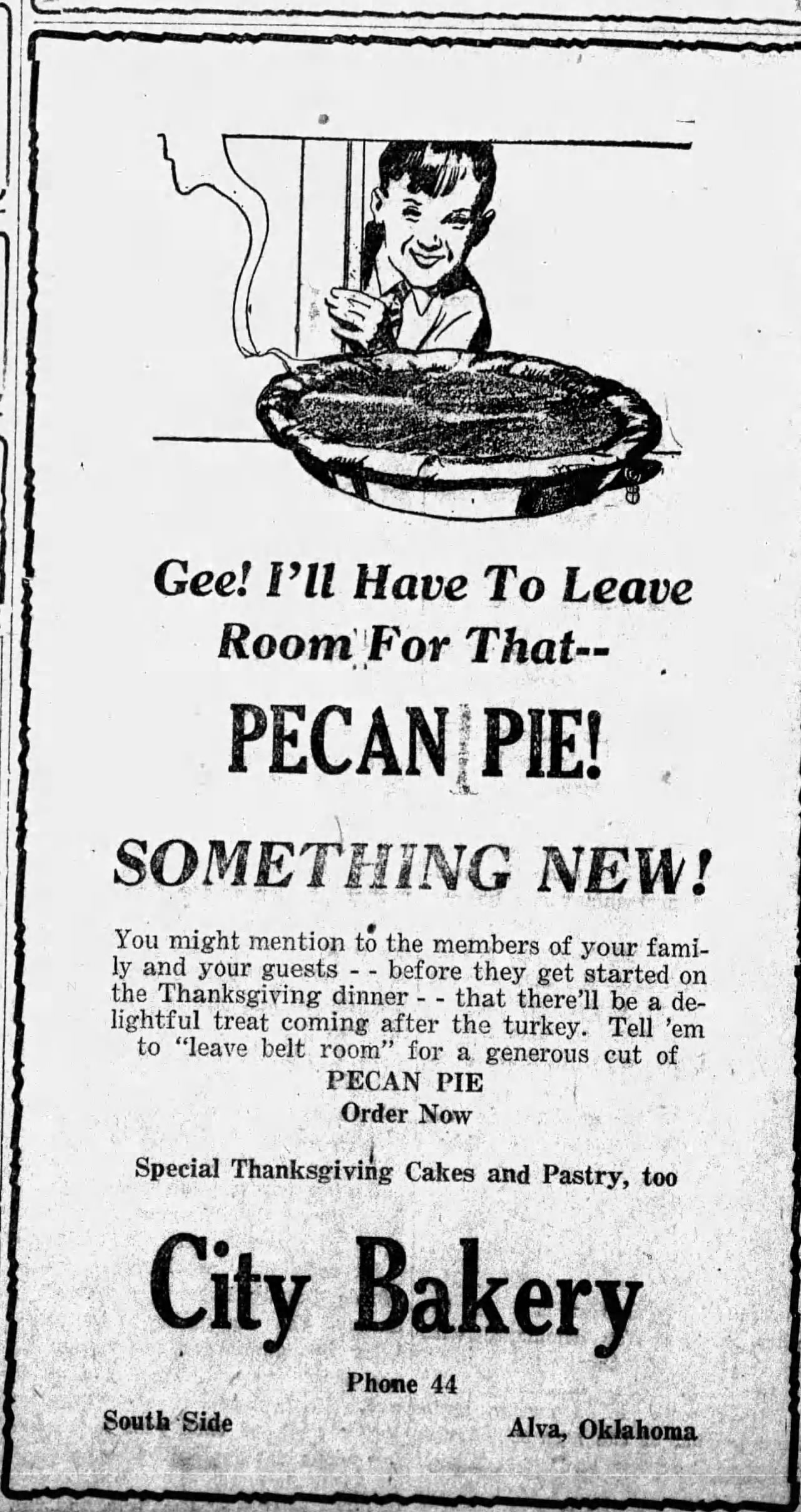
Spurred by government efforts to promote pecans as a healthy, domestic “Victory Food Special” during World War II, pecan production rose and prices dropped resulting in a postwar bounty. Both food manufacturers and homemakers took notice and a part of the postwar reconstruction of civilian life would be the anointing of pecan pie as a Thanksgiving tradition.
Conclusions
Bangs are rare; whimpers are common. History happens through small changes as people adapt and innovate. That is the story of pecan pie's invention and its widespread embrace as a signature Southern dish and a Thanksgiving tradition.
I stumbled into this project expecting to write a simple tale about why pecan pie was so popular in Mississippi, but the story that has emerged is much more than I expected. The creation of a new pecan pie made with corn syrup demonstrates the creativity of American homemakers. Pecan pie is simple, but collectively thousands of cooks across decades experimented, revised, and reinvented. They did not wait for Karo and company to tell them what worked; they discovered it themselves.
The rise of the pecan pie not only reminds us that our most cherished recipes may not be nearly as old as we imagine but also is a warning that our historical memory plays tricks on us. What we eat reflects not only who we are, but who we want to be—and in the twentieth century, the corn-syrup laden pecan pie offered Americans a gooey, sugary idyll they needed.